NEXT GAME
You might also like
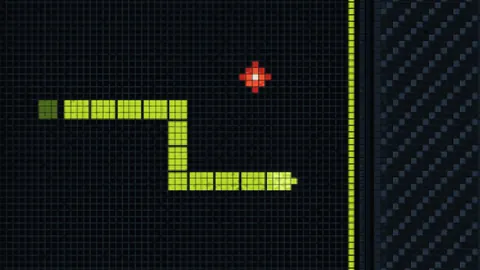
01 / OVERVIEW
About Two-Player Snake
Two-Player Snake turns snake from a solo score chase into a fight over one piece of food. The board is a square field 13 cells on a side with solid walls and no wrapping. Each snake starts 3 segments long, one from the left facing right and one from the right facing left, the two spawns exactly 180 degrees apart — so neither side gets a geometric advantage. It is a pure front-end page: open it and play, no sign-up and no download. There is exactly one thing to do: turn with the four arrow keys on your own band. Each band only answers to fingers inside its own rectangle — whichever band your finger lands on owns that press, and crossing the middle later does not change it, so both of you can press at once without interfering. A round lasts at most 45 seconds; when somebody crashes the picture freezes for 2 seconds and says what they hit, then the next round starts by itself with nothing to tap.
The screen was one small square, dark dots on green, passed back and forth across a desk at break. Two of you crowded over it, one pressing and the other watching, muttering 「left, left — not that left」. Neither wanted to let go, so you split the job: you take the turns, I watch the road, and when the snake got too long to steer you both shouted at once. Screens got bigger after that, and somehow the reason for two people to huddle over one of them went away. This puts that little square back in a browser and fixes what you could not do then: two snakes, two bands, one piece of food. Lay the phone on the table and nobody has to wait their turn.
02 / HOW TO PLAY
How to play Two-Player Snake
- 01
Both snakes are already parked at their own end with the food on the board — tap the field to start.
- 02
A 3-2-1 count-in runs first and each band flashes once to say which side is yours. Turns are ignored during the count-in, but the keycap still presses so you can see the input arrived.
- 03
The left band drives the left snake and the right band the right one. Tap an arrow once to turn; you never have to hold it.
- 04
After a press, an arrow appears on the cell ahead of your head before the snake actually turns — that arrow is how you know the input was taken.
- 05
Race for the food in the middle: eating grows you one segment, your side's food readout pops, and a new piece appears somewhere else.
- 06
To block, lay your body between them and the food. The moment their head is right up against your body — touching it on any of the four sides — their head picks up a bright outer ring saying so, and getting around the blockage means giving up the food.
- 07
After a crash the picture freezes for 2 seconds and a line under the field says what was hit and who scores, then the next round starts by itself.
- 08
There are three ways to pause: the pause key in the system row, your own band's confirm key, or Esc / P on a keyboard. The snakes and the clock both stop where they are.
- 09
On a desktop the arrows plus Enter drive the left snake and W A S D plus Q the right one; the two sets sit far apart on the keyboard so simultaneous presses do not swallow each other.
03 / RULES
Two-Player Snake rules
The board is a square field 13 cells on a side with solid walls, no wrapping, exactly one piece of food at a time, no pickups and no abilities. The snakes move in step — on one step each moves either 0 or 1 cell, so there is no first player. Seven rules are the whole game: hit a wall and your round is over; biting yourself counts the same; ram the other snake's body and you die while they live; head to head or straight through each other draws the round; each piece of food grows you one segment and scores 1; if nobody crashes in 45 seconds the longer snake takes the round; first to 3 round wins takes the match, and after five rounds without a 3 the most food eaten wins. Following your own tail is not a collision, because that cell was going to be vacated on this step anyway — but on the step you eat, the tail does not shrink, and stepping there then really is stepping on yourself. Two snakes reaching one piece of food on the same step is a legal position: both count the food, the board refreshes once, and because both heads end on one cell the round is drawn as a head-on — what was eaten is not taken back. Speed runs through 6 tiers, read off the food the two of you have eaten this round: every 4 pieces between you moves it up a tier, cutting the time each snake spends per cell from 233 ms to 117 ms, and it caps once your combined count hits 20. Tiers go by the combined count, not your own — let them eat a streak and your snake speeds up with theirs. If the two snakes fill the board, that extreme is judged the way the clock is: the longer snake takes the round and equal lengths draw it. Rounds roll on by themselves with nothing to tap; only the match end brings up a card. Adding ?seed= plus a number to the URL replays the same food sequence, so you can hand a whole match to your opponent to go over; a number that does not parse is simply ignored and never blocks the start.
04 / STRATEGY
Two-Player Snake strategy tips
The common beginner mistake is to run the shortest path to the food every time. Both snakes want the same piece, so the move that pays is the one that makes it unreachable: lay your body between them and the food, and when their head picks up the bright ring they know they are up against your body — getting around it hands you the piece. Second: remember where your own tail is. On the step you eat, the tail does not shrink, so a tight circuit around your own body turns into suicide on exactly that step — lead the head away from the body first, then resume the loop. Third: do not gamble on a head-on. A collision is a draw and nobody scores, so winning a round means letting them go down alone. Fourth: the speed is shared. Tiers are read off the food the two of you have eaten this round, so if you let them run a streak your own snake drops from 233 ms a cell to 117 ms right along with theirs. Last: use the clock. At 45 seconds the longer snake takes the round, so when you are ahead you can simply hold your space and let the time run out.
05 / FAQ
Two-Player Snake FAQ
- How do two people play snake on one screen?
- One device is enough. There are two control bands on screen, the left one driving the left snake and the right one the right snake, and you press at the same time. Each band answers only to fingers inside its own rectangle: whichever band your finger lands on owns that press, and crossing the middle later does not change it, so simultaneous presses never fight. On a desktop one player can use the arrows and the other W A S D.
- How is two-player snake different from classic single-player snake?
- Two more ways to die and one less piece of food. There is only ever one piece on the board and both of you want it; ramming the other snake's body kills the one who rams and leaves the one who is rammed alive; and two heads entering one cell, or swapping places straight through each other, is a draw. Walls, biting yourself and growing a segment per piece work exactly as they do solo. Two pieces of food would let each snake feed on its own and the game becomes two people score-chasing side by side — one piece is what makes 「every bite you take is a route they lose」 true, and its colour belongs to neither player. The spawn also avoids cells both snakes would reach at the same time on a shortest path, which keeps the opening from forcing a collision. The other difference is the format: you play rounds rather than chase a score, and first to 3 round wins takes the match.
- Who loses when the two snakes crash into each other?
- Neither — the round is drawn and nobody scores. Both heads entering one cell, or the two swapping places straight through each other, are judged as a head-on. One hitting a wall while the other bites itself on the same step is a draw too: two accidents on one step have no order, so calling either of them the survivor would be invented. Only 「one went down and the other did not」 scores, and then it is the rammer who dies and the rammed who lives.
- How long does a two-player snake match last and how many rounds win it?
- First to 3 round wins takes the match. A round runs at most 45 seconds plus the 2-second freeze after a crash, so a typical match is 3 to 4 rounds and two or three minutes. After five rounds with nobody on 3, the most food eaten wins and equal food draws the match; if nobody crashes inside the 45 seconds the longer snake takes that round, equal lengths draw it, and the clock is mirrored on both bands so neither of you has to read across the other. Rounds roll on by themselves with nothing to tap. A mid-match refresh only replays the round you were in — decided rounds stay on this device.
- What are the best tips to win at two-player snake?
- Three things pay better than racing for the food. Lay your body between your opponent and the piece so they have to go round; on the step you eat, lead your head away from your own body first, because the tail does not shrink on that step and a tight circuit turns into suicide right there; and when you are ahead, hold your space and let the 45 seconds run out, since length decides the round. One more thing to budget for: the speed is shared. Tiers are read off the food the two of you have eaten this round, so letting your opponent run a streak drops your own snake into the fast tiers too.
- What are the keyboard controls for two-player snake?
- The left snake takes the arrow keys plus Enter and the right snake takes W A S D plus Q, with Esc or P to pause. The two sets sit far apart on the keyboard, so two people side by side can press at the same time without swallowing each other's keys. Tap a direction once to turn — you never hold it — and an arrow lights up on the cell ahead of your head before the snake actually turns, which is how you know the input was taken.