Hold inside the defence line and drag. Firing happens on its own.
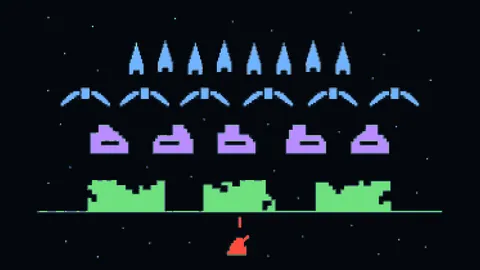
The field: a jointed swarm presses down one row at a time and folds down a row whenever it walks into a nail. Off-white nails are scattered across the field, the dashed line near the bottom is the defence line, and your gun is locked inside it, moving freely and firing on its own.
100noneNEXT GAME
You might also like
01 / OVERVIEW
About Centipede Defence
Centipede Defence is an original browser arcade shooter built on the public mechanics of the upright cabinets of the eighties and nineties; the name, the art, the sound and the levels are all our own. Learn one thing first: there is no fire key. The gun fires continuously on its own, and your only job is to put it on the column that needs shooting. A swarm walks sideways along the top row, folds down a row and reverses whenever it meets a nail, and once it is inside the defence line it bounces up and down in there — so hiding at the top is not a strategy this game permits. Hitting a body segment cuts one chain into two and grows a full-durability nail in the gap; hitting the head pays ten times as much, but the segment behind it becomes a new head and charges back the other way. The real decision here is terrain, not aim. The nails are yours: they fold the swarm toward the row you want, and they also wall off your own escape routes. When the nail count behind the line falls below this wave's threshold, a dropper comes down a column to reseed them. That readout is therefore the one difficulty dial you hold — clear too thoroughly and the dropper comes, leave too many and the swarm folds down on you faster. The spider is the other threat: it skitters diagonally inside the line and eats whole nails, and shooting it pays by vertical distance in three bands, the closer the better. It is the one place in the game that rewards taking a risk on purpose. There are exactly four ways to die, each one named in the summary, with the culprit frozen in place and outlined — you never have to guess. Three lives: a death costs one, repairs every nail to full and restarts the same wave with the wave number unchanged. Only an empty life count ends the run. Score, lives, wave and the nail count behind the line are all readable in a still frame, with no scrolling and no waiting for an animation.
It was the row of upright cabinets nearest the arcade door, with a ball sitting in a metal ring on the counter that sent the little thing on screen running when you shoved it with your palm. A green jointed creature came down from the top of the screen a segment at a time, and when you shot through it the thing became two, each wandering off on its own, with a small white lump left standing where the segment had been. You probably did not think of that lump as terrain — you just remembered that the more lumps there were, the harder the thing folded. The scary part was never the swarm. It was the blue thing that came bounding in diagonally from the side: when it arrived, everyone watching over your shoulder drew breath at once. This game rebuilds what was actually going on in that memory — one shot cuts a segment and leaves a nail, and the nail folds the swarm toward you — with the name, the art, the sound and the levels all written from scratch.
02 / HOW TO PLAY
How to play Centipede Defence
- 01
It plays straight away — no sign-up, no download. You first see a demo: the swarm pressing down, the gun firing on its own underneath. One tap on the screen, or one press of an arrow key, starts the run.
- 02
On a phone, put a finger on the screen inside the defence line and drag: a white anchor ring appears where you landed and the gun rides one whole cell above it, so your finger never covers the gun itself.
- 03
Do not look for a fire key. Firing is automatic and at most three shots are in flight at once. Your job is to move the gun onto the column you want to hit and let the shots arrive.
- 04
On a desktop, arrow keys or WASD move the gun, Esc and P pause, Enter starts and replays. Space is not a fire key, because this game has no fire key.
- 05
A body segment pays 10 and cuts the chain in two, with a full-durability nail left standing in the gap; the head pays 100, and the segment behind it becomes a new head heading the other way.
- 06
A nail has 4 durability, so it takes four shots to clear and pays 1 when it goes. Any nail folds the swarm down a row: the one that was hit is outlined and an arrow pops out directly beneath it, so you can see which nail did it.
- 07
Before a spider enters, the edge of the screen on its side lights up with a dashed vertical band. It skitters diagonally inside the line and eats whole nails. Shooting it pays 300, 600 or 900 by vertical distance — the closer, the more.
- 08
Watch the nail count behind the line. When it drops below this wave's threshold a triangular warning lights up beside it and a dropper comes down a column to reseed; shooting it pays 200. To switch it off, just leave a few nails standing.
- 09
The swarm head, a split head, the spider and the dropper all cost a life on contact. Three lives: a death repairs every nail to full and restarts the same wave, with the wave number unchanged. Only an empty life count ends the run.
- 10
Mute, reduce flashing and switch control scheme are reachable in every state; pause works while playing or paused, and rules and controls while playing, paused or on the settlement screen. If you want real key feel, switch to the d-pad scheme.
03 / RULES
Centipede Defence rules
The field is an 18 by 22 grid and the bottom 6 rows are inside the defence line, where your gun moves freely in both axes. Nails may stand anywhere from the third row down. A run opens with 34 full-durability nails, every one of them above the line, and all 108 cells inside the line are guaranteed empty — that is a property of the generator, not luck. Each wave the swarm is born as one chain on the top row, walks sideways, and folds down a row and reverses whenever it meets a column edge or any nail. On the bottom row it flips to travelling up, and at the top of the line it flips back to down, so it will always come and find you. Scoring: a cleared nail 1, a cut segment 10, the head 100, a dropper 200, a spider 300 / 600 / 900 by vertical distance, and a cleared wave 100. The head paying ten times a segment is deliberate: cutting is a terrain investment rather than the optimal line, and a wave shot entirely in the head always outscores cutting first. There are no bonus lives; the life count only ever falls. Clearing a wave adds one to the wave number and keeps the nail field cell for cell. Swarm speed, chain length, spider period, spider speed and the dropper threshold never move the easy way from wave to wave, and all five are capped by wave 7 — past that not one number rises again, and the only thing that gets harder is the nail field you built. The wave number stops at 999 and play is unchanged. A refresh does not wipe the run: score, lives, wave number and the nail field are kept cell for cell and you come back to the head of the current wave, with no resume dialogue to answer. Switching to another tab pauses the game and waits for you to continue by hand. The calendar key beside Play again in the summary opens the run on today's shared board: the start is derived from the calendar date in universal time, so every press on the same day gives the same run and a new day brings a new board, and a calendar mark stays lit beside the wave number for as long as that run lasts. Play again goes back to an ordinary random start. To replay one particular run instead, add a ?seed= parameter to the address.
04 / STRATEGY
Centipede Defence strategy tips
The first habit to drop is chasing the swarm. The gun is faster than every enemy in the game, so you can always catch up; what actually kills you is being walled into a corner by your own nails. The second is to treat cutting as investment: cut repeatedly in one column and you build a pillar of nails there, and the swarm folds down that side row by row. You can use that to herd it to the far half of the screen — or to invite it straight into your face. The third is to hold the nail count behind the line. Below the threshold a dropper comes, but a dropper is also a 200-point target, so once you are comfortable you can push the count down on purpose and farm them. The price is that the low-durability nails it leaves behind chop your escape routes into pieces. The fourth is that the spider is worth the risk: point blank it pays 900, ninety times a segment, but it shares the space inside the line with you and contact costs a life. That dashed edge band before it enters is your only warning — decide then whether to go and meet it. Last: hugging the bottom row lowers your effective rate of fire, because a shot has to cross the whole field before it leaves and only three can be in flight. Stand a little higher for denser fire, and accept being closer to the swarm.
05 / FAQ
Centipede Defence FAQ
- How do you shoot in Centipede Defence?
- You do not. Firing is automatic and the game has no fire key. Move the gun onto the column you want to hit and the shots go up on their own. At most three are in flight at once, so the next one leaves only after an earlier one lands or exits.
- How do you move the gun on a phone in Centipede Defence?
- Put a finger on the screen inside the defence line and drag: the gun follows your finger and rides one whole cell above it, so your finger never covers it. The phone is the primary scheme — start, summary and the next run all take one finger and no keyboard. If you want real key feel instead, switch to the d-pad scheme on the control bar.
- What do the nails in Centipede Defence do, and should you clear them?
- They are terrain, not just obstacles: the swarm folds down a row and reverses whenever it meets a nail, so the nails you shoot into existence decide where it walks. A nail has 4 durability and takes four shots to clear, and clearing pays 1 — but think first, because that nail may be the wall holding the swarm away from you, and a line swept too clean calls a dropper.
- What makes a dropper come down?
- One number only: the nail count behind the defence line. When that count is strictly below this wave's threshold, no dropper is on the field and the cooldown since the last one has passed, a dropper comes down a column to reseed. Equal to the threshold does not trigger it, so leaving a few nails switches it off.
- Why does shooting a spider sometimes pay 900 and sometimes 300?
- It pays by vertical distance in three bands: within 2 cells pays 900, 3 to 4 cells pays 600, and more than 4 cells pays 300. Point blank is worth far more, but the spider shares the space inside the line with you and contact costs a life — it is the one place in the game that rewards a risk.
- How many waves does Centipede Defence have, and when does the difficulty cap?
- The wave number runs to 999 and the difficulty is fully capped by wave 7. Swarm speed, chain length, spider period, spider speed and the dropper threshold only ever rise from wave to wave, and past wave 7 not one of them moves again. A run goes until your three lives are gone — there is no countdown — and the only thing still getting harder is your own nail field getting crowded.
- How do you get a high score in Centipede Defence?
- Shoot heads and cut as little as you can: the head pays 100 against a segment's 10, so a wave taken entirely in the head always outscores cutting first. Then take spiders close in — inside 2 cells one is worth 900. Last, hold the nail count behind the line near this wave's threshold so droppers keep arriving as 200-point targets, and accept that the low-durability nails they leave will chop your escape routes into pieces.