Mode and level apply to the next game
Yours 0
Theirs 0
NEXT GAME
You might also like
01 / OVERVIEW
About Military Chess
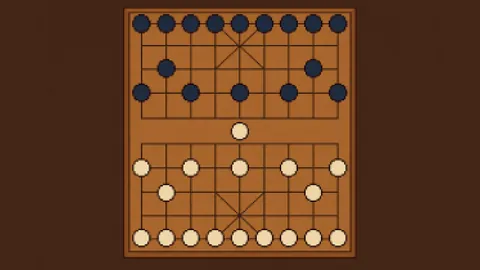
Military chess — also written land battle chess, or junqi — is the folded-card board game that sat in a school desk for decades. This page is the open game: a 5 by 12 board of 60 squares, 25 pieces a side filling every non-camp square of your own half, camps empty at the start, and you always play red and move first. Every piece is face up, so there is nothing to guess: you can recompute every move the opponent makes. Tap one of your movable pieces and its targets light up, then tap a lit square to commit; tap the same piece again to cancel, and use take-back if the move itself was wrong. The band across the middle is the map of this game: two stretches of barrier nobody crosses and exactly three gaps, two of which are railway junctions — a major general can run from your own front rank straight into the far half. For two players, switch to the face-down game: 50 pieces fill the 50 placeable squares back up, and whoever turns the first piece over commands whichever colour it turns out to be.
The sound of a folded card board opening out, plastic tiles rattling in the box, a break between lessons just long enough for a dozen moves. There were always two games in that box: the open one, where everything is visible and the contest is arithmetic, and the face-down one, where you use whatever you turn over. A stone table outside, a desk drawer, a cousin's living room at new year — those are where military chess actually happened. This page puts that card board in a browser: the bars still carry the rank, the front still has only three gaps, and a move is two taps.
02 / HOW TO PLAY
How to play Military Chess
- 01
Your army is the bottom half: you always play red and move first, the setup is already dealt, and tapping Start or anywhere on the board begins the game.
- 02
Tap one of your movable pieces. Empty squares it can reach show a pip, pieces it can attack get a ring, and the status line names the piece and how many targets it has.
- 03
Tap a lit square to commit. Meeting an enemy piece plays a short exchange that has to finish before the board accepts input again.
- 04
Tapping the same piece again cancels. Tapping a square it cannot reach costs nothing at all — the status line explains why and the move number does not change.
- 05
Take back if the move was wrong: against the AI it rewinds two moves, yours and its reply; in the two-up game it rewinds one.
- 06
The engineer is the only piece that clears a landmine, and the only one that turns corners on the railway. A bomb destroys a landmine but is lost with it.
- 07
On a desktop the arrow keys move a cursor between the lit squares, Enter commits, U takes back, Esc or P pauses. On a phone it is all tapping — no dragging, no long press.
03 / RULES
Military Chess rules
The board is 5 columns by 12 rows, six rows a side, with a front band across the middle holding two stretches of barrier and three gaps: a railway junction on each flank and a road in the centre. Ranks run commander, general, major general, brigadier, colonel, major, captain, lieutenant, engineer, and the number of bars printed on a piece is its rank — nine for the commander, one for the engineer. A piece moves one step along a road, or any distance straight along the railway, provided both ends are on rail, they share a rank or file, and every square between them is empty. Only the engineer turns corners on rail: its range is the whole network of connected empty rail squares. A piece inside a camp cannot be attacked, and an empty camp can be entered and left again. A piece that enters a headquarters can never move again, and a headquarters offers it no protection. There are six outcomes and no more: higher rank takes lower and holds the square; equal ranks are both lost; lower into higher loses the attacker only; a bomb destroys both pieces and nobody holds the square; only the engineer clears a landmine and then holds that square, while anything else is lost and the mine stays; taking the flag ends the game at once. The end is judged in order: a flag leaving the board wins for the other side, a side with nothing movable left loses even if its mines and flag remain, and a side whose turn arrives with no legal move loses. 40 moves with nothing lost is a draw, and so is reaching 180 moves.
04 / STRATEGY
Military Chess strategy tips
A reliable order to think in: look for enemy pieces sitting on the railway, ask whether your move can be answered by something bigger, and only then push forward. The engineer is worth more than a captain: it is the only piece that clears a landmine, and clearing one scores 10 against 6 for taking a captain — so do not trade it away. Keep a bomb until something big is moving, because it is an even trade against any piece; the front rank may not hold a bomb, so do not plan to defend the first line with one. The railway is the motorway of this board: a big piece parked on it threatens a whole line, and any piece at all standing in the middle — a landmine included — breaks that line in two. The key move in the summary is the single move that swung the score most, earliest one on a tie. It is the position to replay before the next game.
05 / FAQ
Military Chess FAQ
- How do you play military chess, and what is the order of the pieces?
- A move is two taps: your piece, then a lit square. Ranks run commander, general, major general, brigadier, colonel, major, captain, lieutenant, engineer, and the bars on a piece are its rank. Higher takes lower and equal ranks are both lost.
- How many pieces are there in military chess, and how many of each rank?
- Each side has 25 pieces, 50 on the board, and they exactly fill the 25 non-camp squares of your own half — the 10 camps are empty at the start. One commander and one general, two each of major general, brigadier, colonel and major, three each of captain, lieutenant and engineer, plus 2 bombs, 3 landmines and 1 flag. Mines and the flag never move, so a side has 19 movable ranked pieces and its 2 bombs.
- What is the engineer for, and why is it the only piece that clears mines?
- The engineer has the lowest rank but two abilities nothing else has: it is the only piece that clears a landmine, holding that square afterwards, and the only one that turns corners on the railway, reaching the whole connected network of empty rail squares.
- How does a bomb work, and can a bomb destroy a landmine?
- A bomb destroys any piece it meets and is lost with it — the flag is the one exception: taking it ends the game and the bomb survives. It has to actually walk onto the square; there is no throwing it. It does destroy a landmine, but both are gone and nobody ends up holding that square. The front rank may not hold a bomb.
- How do you set up military chess, and where do the landmines and the flag go?
- Three hard constraints: the flag goes in one of your two headquarters, the 3 landmines may only sit in your last two rows, and the 2 bombs may not sit in the front rank. The other 19 movable pieces fill the rest of your non-camp squares, and all 10 camps start empty. Every setup on this page is generated fresh and checked against those three rules, so an illegal one never appears — tap Deal again on the start screen for another.
- How far can a piece move along the railway?
- Any distance in a straight line, as long as both ends sit on rail, they share a rank or file, and every square in between is empty. Any piece standing in the middle breaks the line, and that includes a landmine.
- What does a camp do, and can a piece inside one be taken?
- A camp is a shelter: a piece inside it cannot be attacked, so it never appears in anyone's set of targets. Either side may enter an empty camp and walk out again. There are 10 camps and all of them are empty when the game starts.
- Can a piece leave a headquarters once it has entered?
- No. A piece that enters a headquarters can never move again, which is how a side can still have pieces and yet no legal move at all. A headquarters offers no protection either — the piece inside can be taken, and the flag sits in one of them.
- How does the face-down game work, and who gets which army?
- The two-up game puts 50 pieces face down on the 50 placeable squares. A turn does one thing: turn a piece over, or move one of your own already-revealed pieces. Whatever colour the first player turns over first is the army they command, and both sides are then fixed.
- When is a game of military chess a draw?
- Two ways: 40 moves in which neither side loses a piece, or 180 moves in total. Note that a side whose turn arrives with no legal move does not draw — it loses, even with plenty of pieces still on the board.
- How many difficulty levels are there, and when does a change apply?
- The built-in AI has three levels that search progressively deeper; the easiest one only compares material and ignores the threat to your flag. Changing level only affects the next game — the current one never changes strength halfway, and the key says so.