Hold the band below and slide. It fires itself.
NEXT GAME
You might also like
01 / OVERVIEW
About Formation Strike
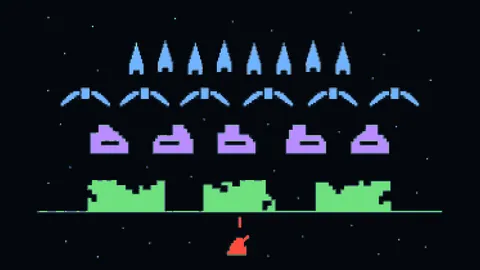
Formation Strike is an original browser arcade shooter. Twenty craft fly in as four groups of five, sweep through your firing line on the way to their slots, and then the whole squadron breathes slowly left and right. They never press down on you in rows — they leave one at a time. A DART walks straight at the cell you are standing on, a WING aims three cells further outside you and sweeps past at your own height, and a LEAD aims above you in your own column. Shooting one outside the formation is worth double the same craft inside it, so every wave asks the same question again: park and farm, or go up and take the multiplier. The leader carries a second threat: it can leave the formation alone, glide down and open a tractor beam. Sit in that beam for three quarters of a second and you lose a life and your wingman, which now rides the top of the squadron. The only way back is to shoot that leader while it dives or flies home — worth a thousand points and a second craft with double the firepower. Three lives and the run is over.
One cabinet by the shop door, one coin, and a neat squadron hanging across the top of the screen — then one of them breaks ranks and comes down at an angle. What stuck was never the score. It was the moment one of them hauled your wingman up to the top of the formation and left it hanging there: for the next two waves you watched nothing else. When it finally dived and you got it, the wingman dropped back alongside your hull and your firepower doubled, and everyone watching over your shoulder made the same noise. Losing something and then taking it back by hand was the first long story that generation ever played through.
02 / HOW TO PLAY
How to play Formation Strike
- 01
Tap once inside the game area to start. On a phone, hold the band under the picture and slide left or right; the ship follows. On a desktop use the arrow keys or A and D.
- 02
The ship fires on its own — there is no shoot button to press. Space or K on a desktop takes the same path; it nudges the shot, it does not raise the rate of fire.
- 03
The wave opens with half a second of stillness. Nothing has flown in yet, but you can already move and shoot — use it to line the ship up on the column you want, so the first group flies into your fire as it arrives.
- 04
Shoot whichever craft has already left the formation: it is worth double the same craft in its slot, and it is the only kind that shoots back — killing it early scores and survives at once.
- 05
A leader takes two shots. The first only cracks its hull and pays nothing, but that shot also cancels its tractor beam — the cheapest insurance in the run.
- 06
Esc or P pauses at any time, and the pause panel has a Rules button with the one-line rule for each of the three craft. The four keys along the top are sound, reduced flashing, intent marks and pause, reachable in one press in every state.
03 / RULES
Formation Strike rules
Field and roster: the field is 16 columns by 14 rows and the squadron holds a 6 by 4 block of slots across the upper half. A full wave is twenty craft — twelve DART, six WING, two LEAD.Entry: a wave arrives as four groups of five, 0.8 seconds apart, each group flying its own route down through your firing line; a craft can be shot down on the way in and pays the outside-the-formation rate.The three one-line rules: DART — it walks straight at the cell you are standing on. WING — it aims three cells further outside you, so it sweeps past at your own height from the outer side. LEAD — it aims above you in your own column; change column and it changes target. By default every diving craft marks the cell it is currently aiming at in its own colour; the third key along the top turns that off.Scoring: in the formation a DART is 30, a WING 50 and a LEAD 150. Outside it — entering, diving or flying home — a DART is 60, a WING 100 and a LEAD 400. DART and WING are exactly double outside; the LEAD is 400 against 150, or 2.67 times, because it also costs a second shot. Recovering your wingman pays a separate 1000.Firing: three of your shots on screen at once, with a fixed cooldown between them, so the rate of fire is a constant 6.7 per second. Pressing fire while the cooldown runs gives an explicit refusal, never silence. Only craft that have left the formation shoot back; the ones in their slots do not.Capture and rescue: about every ten seconds an undamaged leader in the formation flies out alone, glides to mid-field and opens a beam 24 pixels wide. Your ship has to overlap that beam for 0.75 seconds without a break to be caught — step out and the counter resets to zero instantly. The beam itself stands for three seconds, so those three seconds are a decision you keep making, not a penalty box. Being caught costs a life and your wingman, which rides that leader's slot. Shoot that leader while it dives or flies home and the wingman rejoins you as a pair: double shot limit, wider hull. Shoot it while it still sits in the formation, or while the beam is open, and the wingman is gone for good. Only one wingman can ever be held.The pair: a pair that takes a hit loses the wingman and keeps the life. It is a conditional life, not a wider coffin.Lives and waves: three lives, and an enemy shot, a collision or a completed capture each cost one. There are no extra lives. Clearing a wave moves you on, and the difficulty steps up per normal wave until it converges at tier seven. Waves 3, 7 and 11 are challenge waves: the craft simply cross the field and leave, sending no dives and firing nothing. Each hit pays 100 and a clean sweep pays a further 5000 — and a challenge wave does not consume a difficulty tier.
04 / STRATEGY
Formation Strike strategy tips
Outside first: the same DART is worth 60 once it has left and only 30 in its slot. A full wave of twenty shot down inside the formation pays 960; waiting for just the twelve DART to leave pays 1320 — 360 more, at the price of twelve close passes.Put one shot into each leader early. It pays nothing, but it permanently cancels that leader's tractor beam — worth it any time you would rather keep your wingman than farm the 400.If you want the thousand, do not tidy the leaders away. The rescue needs the leader that actually took your wingman to die mid-dive or on its way home; killing it in the formation takes the wingman with it.You never need pixel-perfect placement to leave the beam: it is 24 pixels wide, the catch needs 0.75 unbroken seconds, and one slide crosses the whole field. Start edging away the moment a leader flies out alone.The intent marks are free mind-reading. A WING marks the cell outside you, a LEAD marks the cell above you — the mark tells you where to go before the hull does.A craft flying home will still kill you on contact, but it no longer aims at you and carries no mark. Anything with a mark on the field is actively hunting you.A challenge wave is your scoring window: no dives, no return fire, and twenty hits plus the sweep is 7000 — more than seven times a clean normal wave. Do not dodge it; stand under the route.
05 / FAQ
Formation Strike FAQ
- How do you play a formation shooter game on phone and on desktop?
- In Formation Strike you slide the ship left and right to aim and dodge while it fires by itself, and you clear the squadron overhead. On a phone, hold the band under the picture and slide — one slide crosses the whole field, and there is no shoot button on touch. On a desktop use the arrow keys or A and D; Space or K takes the same firing path without raising the rate, and Esc or P pauses.
- How do you score well in a formation shooter?
- Wait for a craft to leave the formation: outside kills are worth double the same craft in its slot. The bigger prize is the rescue — once a leader has your wingman, shooting it mid-dive pays its own 400 plus a further 1000 and turns you into a pair with double firepower. A challenge wave with all twenty hit adds 5000 on top.
- How does scoring work, and how many points is one wave worth?
- Formation Strike pays by craft type and by whether that craft was still in its slot. In the formation a DART is 30, a WING 50 and a LEAD 150; outside it — entering, diving or flying home — a DART is 60, a WING 100 and a LEAD 400. A full wave of twenty shot down inside the formation is 960, while waiting for just the twelve DART to leave makes the same wave 1320. Getting your wingman back pays a separate 1000, and hitting all twenty craft in a challenge wave adds a further 5000.
- How do the enemy craft move in this arcade shooter?
- Each of the three kinds follows one fixed rule. A DART walks straight at the cell you are standing on. A WING aims three cells further outside you, so it sweeps past at your own height from the outer side. A LEAD aims above you in your own column, and it re-aims the moment you change column. Every diving craft marks the cell it is aiming at, so the mark warns you before the hull does.
- My wingman was captured — how do I get it back?
- An undamaged leader in the formation flies out alone and opens a tractor beam; 0.75 unbroken seconds inside it costs a life and your wingman, which then rides the top of the squadron. There is exactly one window to get it back: shoot that leader while it is diving or flying home, and the wingman drops back and joins you as a pair. Shoot it in its slot, or while the beam is open, and it is gone for the rest of the run. One non-fatal shot into a leader also cancels its beam for good.
- How many waves are there, and does it get harder forever?
- The waves have no end, but the difficulty converges at tier seven: the dive interval shortens, dives get faster, more of them fly at once and the enemy fire rate climbs — all four stop changing after tier seven, while the score keeps going. Waves 3, 7 and 11 are challenge waves, which are easier but do not consume a difficulty tier, so the curve never quietly steps backwards.
- What is a challenge wave and how do you clear one perfectly?
- Every fourth wave, twenty craft simply cross the field from one side to the other and leave, sending no dives and firing nothing. Each hit pays 100 and hitting all twenty pays a further 5000, so a clean sweep is 7000 — the highest a single wave can pay. Do not dodge this one: park under the route and let the automatic fire do the work.
- How many lives do you get, and what happens when you are hit?
- Three lives per run, and an enemy shot, a collision with a diving craft or a completed capture each cost one; there are no extra lives. A hit freezes the picture for a moment, and the ship blinks while it respawns — that blink is an invulnerability window, and enemy shots pass straight through it. Once you are flying as a pair, the next hit takes the wingman and leaves the life alone.
- What was that arcade game with a squadron overhead that stole your ship?
- The genre is generally called a formation shooter: a squadron forms up along the top, peels off one craft at a time to dive at a single ship below, and the leading kind can drop a beam that carries your wingman away until you shoot it back and fly as a pair. Formation Strike is an original browser version of that loop — open the page and play; progress stays in this browser.
- Which browser shooter works one-handed on a phone?
- Formation Strike had its whole control layer rebuilt for a portrait phone: the band sits under the picture and never overlaps the battlefield, so your thumb is never in the firing line, and firing is always automatic. One thumb takes you from the opening tap to the summary with no second button anywhere. A run is decided by its seed, so the copy button in the summary hands someone else the exact same run.